
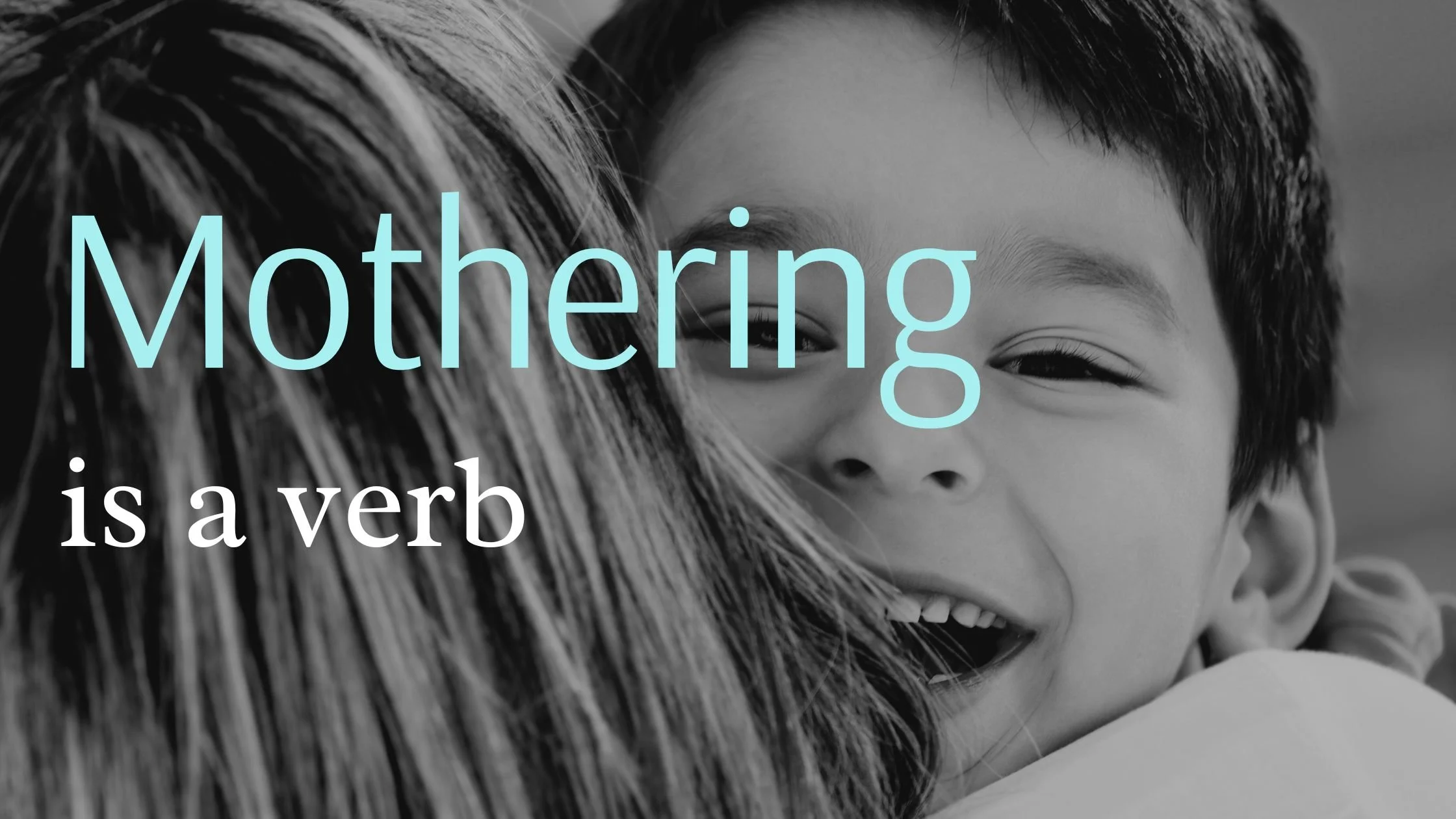
Mothering Is A Verb
Rev. Jen
Psalm 133, Colossians 3:12–17
REFLECTION
You would think that a reflection for Mother’s Day or Christian Family Sunday would write itself! But finding a spark or direction this week for my reflection has felt just out of reach.
I heard a de-influencer once say that if someone is trying to convince you that a complex situation can be fixed with one simple solution - then you can be sure that they are selling you snake oil. There are no simple solutions to complex problems…
And similarly, I think there are no straightforward simple narratives to complex relationships.
Mother’s Day tries to package motherhood into a simple box. With a pretty card. But no doubt everyone here has very different mothering experiences. Some experiences are strong and inspiring. Others are marked by loss, trauma, or heartbreak. And most are a bit of both!
Social media would have you believe that the mothering relationship falls into one of two categories: one of the selfless unconditional bond, or one with the bonds broken to the point of “no contact”.
But when has any relationship been so 2-dimensional?
Let me share my own non-2-dimensional reality. I have 3 women in my life who all have “mother” in the title of their relationship with me. There is my mother, who has been a steady and strong presence in my life since I was three months old. There is my mother-in-law, and there is my birth mother. All are mothers in some way to me - but all are so different I struggle to find any overlap between them. And on the flip side - I myself am a mom to 2 incredible teens. Yet this week alone I went from being too much of an embarrassment to welcome on a field trip on Tuesday, to being the only person one of them wanted with them when they had their wisdom teeth removed.
I am happy to say, that I stayed “cool” enough on the field trip that maybe it won’t be so scary next time I am asked to come along.
But this is just one person’s snap shot of how varied and different each relationship is - and how they can change on a dime and evolve. And truly, should it surprise us that the relationships we build, those that we are born into and those that are sent to us, should be so multidimensional? If building and maintaining relationships were simple, I doubt we would have centuries of scriptures trying to lay out guidance for how to create the space in between us for God to exist.
But back to Mother’s Day…
Did you know? Mother’s Day, as we know it, was created in 1908 by social activist Anna Jarvis, in honour of her late mother who used to organize Mother’s Work Days in the late 1800s. These days were meant to improve the community, bringing people together to improve sanitation, foster community peace during the Civil War, and reduce infant mortality through education and support.
Inspired by the work her mother did, Anna coined Mother’s Day as a way to recognize the sacrifices that mothers make for the whole community. It is said that Anna was distraught when Mother’s Day was taken over by commercialism and tried to rescind the holiday. Because it wasn’t meant to be about creating a 2-dimensional narrative about the saintlyness of motherhood, marked by cards and flowers. It was meant to honour the work of mothering in the wider community - and that goes beyond just those who bear children. That includes the “sent” mothers: the many in the community who step in to play critical roles in creating safe, healthy and strong communities for our youth to grow up in.
And so the United Church found its own path to walk. Recognizing this second Sunday in May, the one we commonly know as Mother’s Day, as Christian Family Sunday instead. Defined by the church as a day to celebrate God’s family, honour nurturing relationships, and reflect on faith within the home. It seeks to lift up broader themes of love, support, and community within the church, similar to that of Mothering Sunday in the UK.
Here’s another fun fact: In the UK, Mothering Sunday occurs earlier in the year. On the 4th Sunday in Lent. The Mothering Sunday tradition goes way back to medieval times and is about returning to one’s “Mother” Church - one’s place of belonging in community.
I like this slightly different turn of the language to Mothering Sunday. The word Mother after all is a noun, and so refers to a person and their role or identity. While the word mothering is a verb. It is an action that can be and is performed by anyone.
Ask Google and it will tell you:
Mothering refers to the act of caring for, nurturing, and protecting someone in a way traditionally associated with a mother. It can apply to biological mothers, adoptive mothers, or anyone who provides maternal care and guidance.
Key Aspects of Mothering:
Nurturing – Providing emotional and physical care
Protecting – Ensuring safety and well-being.
Guiding – Teaching life skills, morals, and values.
Loving – Offering support without expecting anything in return.
So let’s take this active verb of mothering and go back to the wisdom from Colossians
“Since you are all set apart by God, made holy and dearly loved, clothe yourselves with a holy way of life: compassion, kindness, humility, gentleness, and patience. Put up with one another. Forgive. Pardon any offenses against one another, as the Lord has pardoned you, because you should act in kind. But above all these, put on love! Love is the perfect tie to bind these together.”
It sure sounds as though Paul is instructing the people of this new church movement to take on the task of mothering. Not in a gendered way. In a holistic way. Paul says, look out for one another and do it with love.
We live in a fractured time. It is not the first fractured time in history. Ann Jarvis lived in a fractured time when she started Mother Work Days to improve the communities around her. The early church was born out of a fractured time, as communities of people came together to try and figure out a better way forward to live as community. Together.
It wasn’t easy. If it had been, Paul would not have had to write so many letters of encouragement and direction. And it still isn’t easy.
Today, we have mental health issues rocking our youth. We have online messaging distorting what we think it means to belong, and reducing complex relationships to 2-dimensions. There is more and more isolation, for all generations. There are fewer and fewer places where we can plug into a community of diverse ages, experiences and worldviews. And the complex and beautiful ties that once bound us to one another seem to fray as we forget how to mother one another. We forget that mothering is a verb for all of us.
So where is the church in all of this?
The church, at its best, has been a place where different ages, different socio-economic realities, different ethnic and cultural backgrounds have come together to build a common place of belonging. Instead of reinforcing silos of thought, we actively work towards creating harmony with our differences. Look around - We are a beautifully imperfect odd bunch. A family of choice. What a thing to celebrate.
So, this is why the church as important today as it has ever been. We are a living breathing vision of community; where reconciliation with God, ourselves, each other and our world is at the heart of all we do.
There are a lot of challenges in our current times. War, isolation, binary thinking reinforced by media silos. Our challenge is how do we as God’s children, holy and beloved, clothe ourselves with compassion, kindness, humility, meekness, patience and most of all love? How do we live out mothering, where we nurture, protect, guide and love each other?
That answer might be in our reading from Colossians as well.
“Let the word of the Anointed One richly inhabit your lives. With all wisdom teach, counsel, and instruct one another. Sing the psalms, compose hymns and songs inspired by the Spirit, and keep on singing—sing to God from hearts full and spilling over with thankfulness.”
And no, this is not a simple solution to a complex problem. This is an ongoing active process. One that takes work, that stumbles and reinvents, that honours and builds on the successes of those who have come before us, and reaches out into the future towards new dreams and new visions for God’s Kin-dom alive within Creation.
Let us let the wisdom of those before us inhabit our lives and inform us. Let us teach, and support, and guide each other in our different perspectives and experiences. In other words, let us engage in mothering, ungendered and holistic, strengthening community through the bonds of belonging to one another. And in all, let us sing, allowing God’s music to inspire, lift and guide our spirits forward.